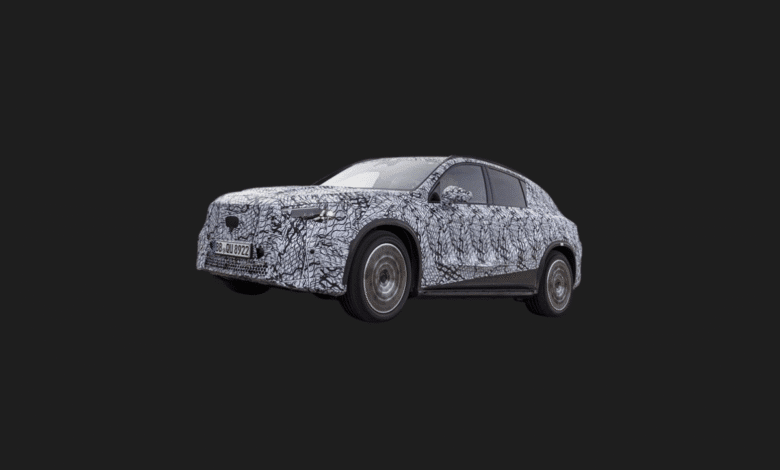

Mercedes-Benz has released the first official images of its new all-electric GLC model, set to be unveiled in September. This vehicle, featuring a bold new design language and an 800V architecture, has been developed to compete directly with the BMW iX3.
This new model represents a significant step in Mercedes-Benz’s electrification journey and marks the debut of the brand’s audacious new design philosophy.
Striking New Design Language

Central to the new design ethos is a more upright and prominent front grille, inspired by the brand’s historical models. Gorden Wagener, Mercedes-Benz’s chief design officer, stated that the aim of this change is “to give models a stronger identity in an era where all electric vehicles tend to look alike.” Wagener summarized the new design philosophy by saying, “Our grilles will continue to play an important role in our brand identity; however, they will now be taller and more striking.”
The new GLC incorporates innovative details such as an illuminated grille surround, first teased in the Vision V concept introduced at the Shanghai Auto Show last April. As the first model built on Mercedes’ next-generation electric vehicle platform, MB.EA, the GLC benefits from an 800-volt electrical architecture. This setup allows for high-performance charging support (320kW+) and more efficient energy utilization. The vehicle’s 94.5 kWh nickel-manganese-cobalt (NMC) battery is expected to offer a range of approximately 700 km on a single charge according to WLTP standards.
Powertrain and Performance

Standard models will offer rear-wheel-drive single-motor and all-wheel-drive dual-motor versions. The AWD version is expected to produce a maximum of 482 horsepower. An AMG version, planned for release in 2027, will boast 600 horsepower and be equipped with advanced axial-flux motors.
The new GLC will replace Mercedes’ current EQC model, aiming to boost electric sales by leveraging the strong brand value of the highly successful GLC nameplate. Unlike models such as the CLA, which offer both ICE and electric versions, the GLC Electric will be an addition to the existing gasoline, diesel, and hybrid GLC variants already on sale.


Advanced Technology and Interior Features

One of the standout technological innovations in the GLC is the new electric powertrain system, named eATS 2.0. This system was first showcased in the 2023 Vision EQXX concept. Alongside the 483-horsepower all-wheel-drive version, a 268-horsepower rear-wheel-drive single-motor option is also under development.
Another notable innovation in the new electric GLC is the One Box braking system. In this system, the brake pedal is completely decoupled from the physical braking system. The vehicle’s computers calculate how much regenerative braking (energy recovery) and how much physical disc braking is needed to perform the braking action. Mercedes officials state that this is revolutionary for both efficiency and driving comfort. Efficiency is further enhanced by a new heat pump, and the vehicle also offers a 100-liter “frunk” (front trunk) under the hood. The rear trunk provides 560 liters of volume, offering more cargo space than the ICE GLC models.
Interior and Driving Dynamics

Inside, the vehicle will feature a pillar-to-pillar digital screen along with the brand’s next-generation MB.OS operating system. While details remain camouflaged in the prototype, the interior is expected to be significantly different from the ICE GLC models. Thanks to an extended wheelbase, the rear seats, in particular, offer generous living space.
The first test drive of the new GLC took place near Arjeplog in northern Sweden, on the challenging Galtispuoda pass. In snowy and icy conditions, the vehicle’s all-wheel-drive system, quick-response ESP, and rear-axle steering system received high praise. Developed by Mercedes-AMG engineers, the system significantly enhances maneuverability with a 4.5-degree rear wheel steering angle.
The new GLC will be produced at Mercedes’ factories in Bremen, Germany, and Beijing, China. Production at the Tuscaloosa factory in the US is also being considered, depending on demand and trade tariffs.
You Might Also Like;